Thermal detection
A 640 × 512 thermal camera. The person reads 31–35 °C; debris, birds, mammals, foam and sun glint read differently. A target is confirmed after five consecutive frames.
Most rescue technology delivers flotation. The person still has to be found, reached, lifted and brought to someone who can help. AmphiReach is a design for a vessel that does all four without a crew.
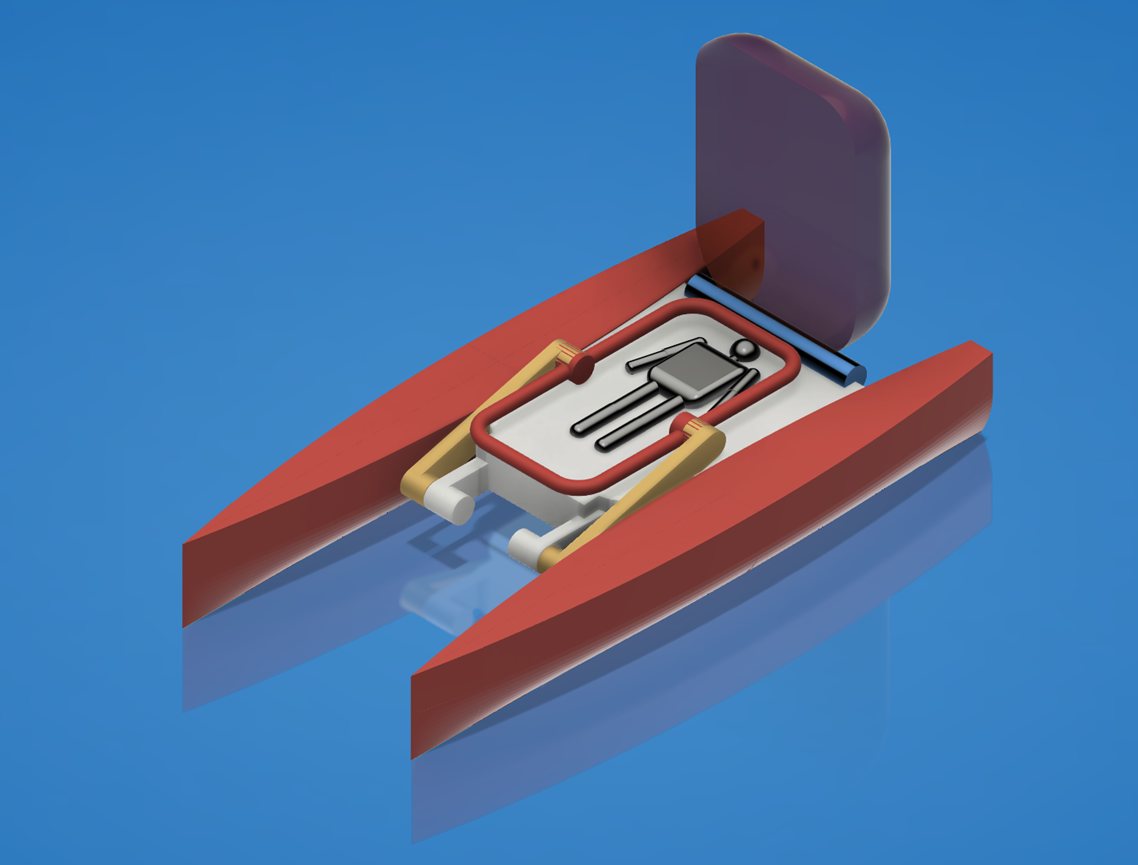
The project started with a question after a bad swim in my first triathlon: could a robot complete an entire rescue on its own? Not a drone that drops a buoy, not a remote-controlled board. A machine that leaves the shore, finds the person, takes them aboard and brings them back.
A twin-hull catamaran, 3.2 m long, with 1.86 m between the hulls. Operating mass 250 kg: 150 kg of structure and a 100 kg casualty. A recovery pod sits between the hulls. A thermal camera looks forward. Tracks under the hulls take over at the shoreline.
The energy and range of the vessel, its buoyancy, and the thermal detection were modelled for the paper. The mission sequence, the cradle, the tracks and the thermal detection exist physically in AR-Mini, at 1:9 of a person. Everything else on this page is a concept.
A 640 × 512 thermal camera. The person reads 31–35 °C; debris, birds, mammals, foam and sun glint read differently. A target is confirmed after five consecutive frames.
Propulsion from a resistance model, hotel loads day and night, a pod heater on the return leg, and two battery packs sized to the mission.
Two separate hulls give the restoring moment. The float check in Gazebo returns the vessel from a 10° heel.
A cradle on a parallelogram arm so the casualty stays horizontal, then a sheltered pod for the way back.
Drift-aware planning for current and wind. In the paper, current and path overhead are drawn per trial, not planned.
Tracks under the hulls so the handoff happens on land.
Loiter behaviours, redundant communication, conservative recovery envelopes.
Adaptive thrust, heading hold and cradle alignment.
Targets, not measurements.
| Target | Value | Status |
|---|---|---|
| One-way range | 10–40 km | Modelled in 24 scenarios |
| Sea state | up to Beaufort 5 | Modelled in 24 scenarios |
| Casualty mass | 100 kg | In the mass budget |
| Detection in low light | 90 %+ | Target. First-pass detection in the paper: 751 of 1,152 trials |
| Shore handoff after arrival | within 10 min | Concept |
Numbers come from the revised manuscript and its repository. If a number is not there, it is not on this site. Technical notes